
Light, Medium and Dark Roast Coffee in New Zealand: What Actually Changes
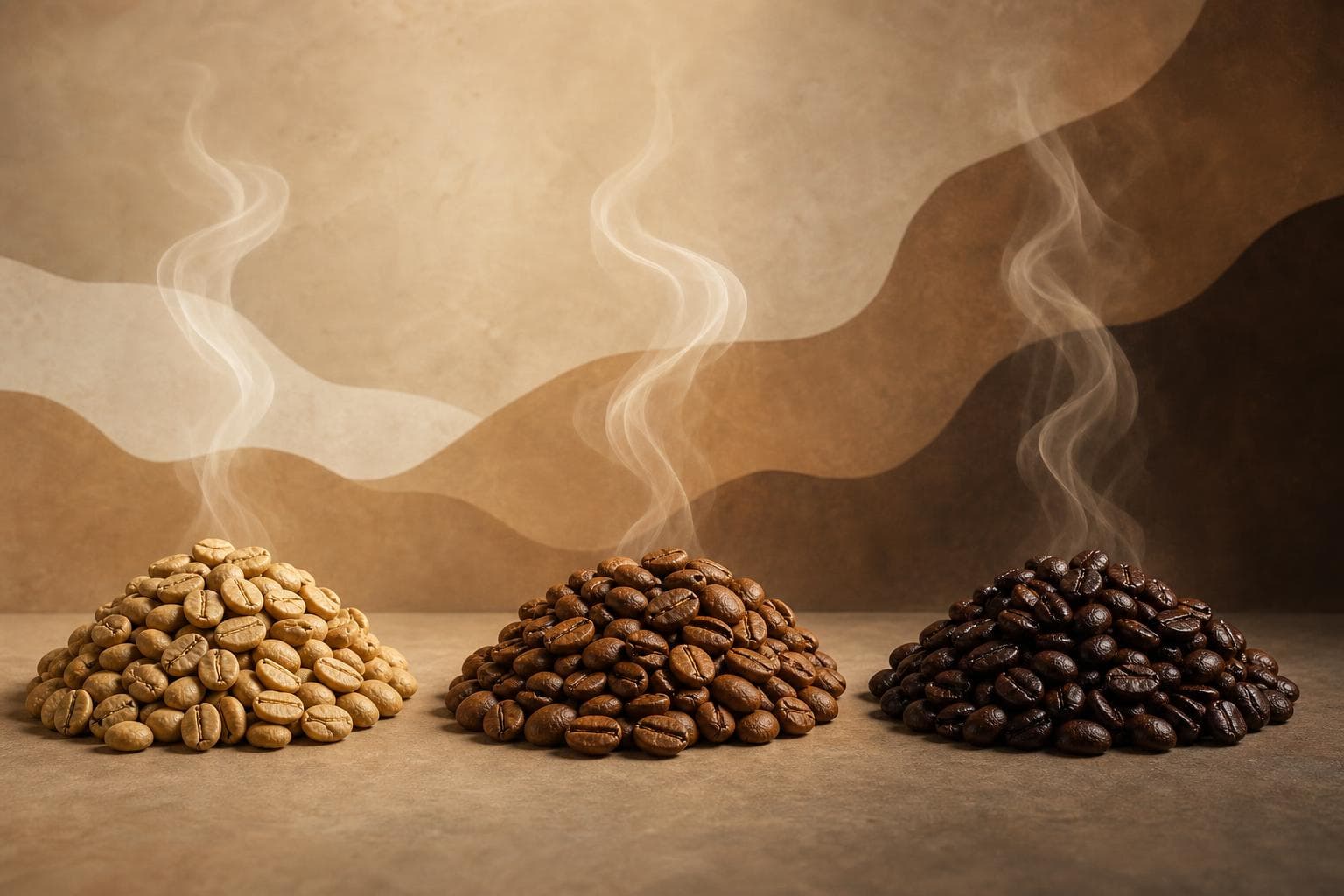
Light, medium and dark describe how far the beans went in the drum. Light stops just after first crack and keeps more of the origin flavour. Medium sits in the middle and suits most Kiwi brewing. Dark goes into second crack for a fuller, smokier cup that holds up in a flat white.
Walk into any roastery and you'll hear the same three words on every bag. Light. Medium. Dark. Nobody tells you what they mean, so most people pick one, get a cup they don't love, and blame the beans.
The beans are usually fine. The roast level is the bit nobody explained.
Roast level is a description of when the roaster stopped. That's it. At Naki Roast we run small batches in Eltham, Taranaki, and we pick a stop point for every blend on purpose, because everything follows from that one decision: how the beans look, how they smell, how fast water pulls flavour out of them, and whether the cup survives a splash of milk. This guide explains what those stop points do, so you can read a bag and know what you're in for.
What Light, Medium and Dark Actually Mean
Roasting green coffee is a heating job with two landmarks you can hear. The first is first crack, a loud popping sound like popcorn, which happens when steam inside the bean bursts its cell walls. The second is second crack, quieter and faster, when the bean's internal structure starts breaking down and oils push to the surface.
Roasters name the levels by where they stop relative to those two cracks. That part is universal. Light roasts come off shortly after first crack, light brown and dry, sometimes with bits of chaff still on them. Medium roasts run further through the development window and come out medium brown with a smooth surface and no oil. Medium-dark goes to the edge of second crack or just into it, and the oils start to show. Dark is taken well into or past second crack, nearly black and oily with a smoky sheen [fn-brewedlate].
| Roast level | Where the roaster stops | Bean temp often quoted | What it looks like | How it tastes |
|---|---|---|---|---|
| Light | Just after first crack | 196°C to 205°C | Light brown, dry, sometimes chaff | Bright and acidic, origin flavour up front |
| Medium | Through the development window | 210°C to 219°C | Medium brown, no surface oil | Sweeter, rounder, balanced acidity |
| Medium-dark | Edge of second crack or just into it | 219°C to 224°C | Dark brown, oils starting to show | Lower acidity, dark chocolate, richer aroma |
| Dark | Well into or past second crack | Above 227°C | Nearly black, oily, smoky sheen | Full body, low acidity, smoky and bitter |
The stop points in that table are universal. The temperatures aren't, and that's worth a section of its own.
Why Those Temperature Numbers Probably Won't Match Your Machine
Nearly every roast guide pins a temperature to each level. The figures above are the ones you'll see quoted most often [fn-brewedlate]. Treat them as one machine's readings rather than a standard, because that's all they are.
Start with the awkward bit: a roasting probe can't measure the temperature of a coffee bean. It records the temperature inside the drum, which only gives an indication of what the beans are doing [fn-pdg-curve]. What that number reads depends on the probe itself, where it sits, how clean it is, and how much coffee is in the drum with it. There's no standardised way to compare roast data between machines, because no two roasting machines are the same [fn-pdg-data]. The working advice from the trade is to stop asking whether your readout is accurate and make sure it's consistent roast to roast [fn-pdg-data].
The practical result: two roasters can pull the same coffee to the same colour with readouts twenty degrees apart, and both of them are roasting correctly.
There is a second lever the temperature charts leave out: time. How long the coffee is held after first crack matters as much as where you stop. Roasters track it as development time ratio, the share of total roast time that happens after first crack. Roughly 15% to 25% tends to land light to medium, and 25% to 35% leans medium-dark to dark [fn-brewedlate]. Hold a roast longer at a lower reading and you'll land darker than a quick run to a higher number.
So if you're buying beans, the degrees on a chart tell you nothing useful. Read the roast level, the tasting notes and the roast date. If you're roasting at home on a manual setup, find first crack on your own machine, write down what your own readout says when it happens, and work from there. Your numbers are the only ones that apply to your drum.
What You Trade Away as the Roast Gets Darker
Every second past first crack buys you body and costs you origin flavour. That's the deal.
Light roasts preserve the most original character. If the coffee grew in Ethiopia or Colombia, you'll taste it: citrus, berry, floral, stone fruit, with higher acidity and a light, almost tea-like body [fn-coffeecollective].
Medium is where the swap starts. Caramelisation from the roast begins to round off the sharp edges. A Colombian bean that tasted like citrus at a light roast will read more like caramel and milk chocolate at a medium [fn-coffeecollective].
Dark roasts trade origin flavour for intensity. Acidity drops to its lowest, body gets full and heavy, and you get dark chocolate, roasted nuts, smoke and molasses instead of fruit [fn-coffeecollective]. Roast a delicate Ethiopian bean that far and you've paid for a farm you can no longer taste.
So "which roast is best" is the wrong question. The useful one is what you want doing the talking. Want the farm? Go lighter. Want a thick, chocolatey cup that cuts through milk? Go darker.
Grind Size and Brew Time Have to Move With the Roast
This is the part that quietly ruins more cups than anything else. People change beans, keep their grinder exactly where it was, and wonder why the coffee went sour.
Light beans are denser and resist water, so they need finer grinds and longer brew times to extract properly [fn-altdrop]. Dark beans have a fractured, more porous structure with oils on the surface. They give up flavour fast, and they do best with coarser grinds and quicker pours [fn-altdrop].
To dial a new bag in:
- Read the roast level off the bag. If it isn't printed, ask the roaster. Any roaster worth buying from will tell you.
- Move your grind first. Finer for light, coarser for dark. One adjustment at a time.
- Then move your time. Longer contact for light. Shorter for dark.
- Taste and correct. Sour or thin from a light roast means grind finer or brew longer. Bitter or ashy from a dark roast means grind coarser or pull faster.
- Match the method. Light roasts reward pour-over and immersion, where there's time to get everything out. Dark roasts suit espresso and moka pot, where the pressure and speed do the work.
If your grinder is the weak link in that chain, our guide to grinding coffee beans at home in NZ covers what to buy and how to set it.
The Caffeine Question, Answered Honestly
You'll see this claim everywhere, so here it is straight.
Published roast guides agree that light roasts carry a bit more caffeine than dark ones. Light beans hold more caffeine than the other roast types, and dark roasts have the least [fn-coffeecollective]. Light roast also holds slightly more caffeine by weight than dark [fn-brewedlate].
Two things worth knowing before you build a morning around it.
The gap is small. Small enough that it won't decide how your morning goes.
And how you measure changes the answer. Dark beans have lost more moisture and are less dense, so a scoop of dark beans weighs less than the same scoop of light. Measure by scoop and light looks stronger. Measure on a scale and the gap narrows.
Pick your roast for flavour and for what you're putting it in. Caffeine is not the deciding factor here.
Why Medium Is the New Zealand Default
Medium roast is the most popular profile across New Zealand and Australia, mostly because it works across different brewing methods [fn-brewedlate]. Balanced acidity, balanced sweetness, enough body to matter [fn-coffeecollective].
That versatility is the whole point in a country built on the flat white. A medium roast has enough caramelisation to stand up to textured milk, and enough sweetness and acidity left to drink as a long black. The same bag works in a plunger on Sunday and an espresso machine on Monday.
Medium is popular because it's adaptable, not because it's safe.
Dark Roast and Milk: Why the Pairing Works
Add milk and the maths changes. Milk mutes acidity and adds sweetness, which means a bright light roast can come through as sour or thin under a flat white.
Darker roasts solve that. If you add milk, medium-dark or dark holds up better [fn-coffeecollective]. Low acidity and a full body give you chocolate and caramel notes that sit under textured milk instead of fighting it.
That's the reasoning behind our OG Roast, which we finish medium-dark and dial in for espresso specifically because most of what leaves here ends up under milk. Dark chocolate, hazelnut and caramel hold their shape in a flat white. A bright light roast in the same cup tends to disappear.
How We Pick Roast Levels at Naki Roast
We're a small-batch roaster at 96 Bridge Street, Eltham, in south Taranaki, and everything goes in the drum once you've ordered it. That means the roast level on each blend is a choice we make for a job, not a house style we apply to everything.
OG Roast is our medium-dark. 100% Arabica, washed, built from Brazil Cerrado, Colombia Medellín and Mexico Altura. Dark chocolate, hazelnut and caramel. It's dialled in for espresso and built for milk drinks, which is exactly what medium-dark is good at. NZ$18 for a 250g bag.
Southern Lights goes darker. Pure Brazil Cerrado, nothing else in the bag, roasted for a dark, rounded, full-bodied cup with a smooth finish and no bitterness fighting through. Single origin taken deliberately dark, which is not the fashionable choice, but it's the right one for this bean. NZ$17 for 250g.
Baghonça is our bold one. Brazil and India in the same bag, Arabica meeting Robusta, roasted to bring out real strength. Robusta gets written off a lot in specialty coffee, which is a mistake we've argued about at length. NZ$17 for 250g.
The Mule is four origins in one bold, rich, full-bodied blend. Built to keep pace with a long shift. NZ$18 for 250g.
And if you'd rather make the call yourself, Lab Rat hands you the drum. You pick the beans from Brazil Cerrado, India Soft Touch, Mexico Altura and Colombia Medellín Excelso, you set the percentages, and you choose the roast: 1st Crack or 2nd Crack. That's this entire article as a single toggle. First crack gives you the lighter, brighter end. Second crack takes you into dark roast territory with the oils and the body. NZ$60 for a 1kg bag.
All prices are in NZD and were checked on 15 September 2026.
One last thing that matters more than roast level: how recently the beans were roasted. A perfectly chosen dark roast that's been sitting on a shelf for four months will still disappoint you. We stamp roast dates on every bag for that reason, and we wrote up why roast date beats best-before if you want the detail.
The Short Version
Light keeps the farm. Dark keeps the roast. Medium keeps the peace, which is why most of New Zealand drinks it.
Work out what you're brewing with and whether milk is going in. That answers the roast question faster than any tasting note ever will.
Looking for a bag? You found us.
Frequently Asked Questions
Which coffee roast is most popular in New Zealand cafes?
Medium roast is the most popular profile across New Zealand and Australia, largely because it works across different brewing methods [fn-brewedlate]. Its balanced acidity and sweetness make it reliable for black coffee and for milk drinks like flat whites, without the extremes of light or dark [fn-coffeecollective].
What is the difference in caffeine content between light, medium and dark roast coffee?
Light roasts carry slightly more caffeine than dark roasts, and dark roasts have the least [fn-coffeecollective]. The gap is small, and how you measure it matters: dark beans are less dense, so a scoop of dark beans weighs less than the same scoop of light. Roast level is not a good way to control your caffeine intake.
Which roast level is best for making a flat white?
Medium-dark or dark holds up better once you add milk [fn-coffeecollective]. Lower acidity and a fuller body mean the coffee reads as chocolate and caramel under textured milk rather than turning sour.
Why do dark roast beans look oily while light roast beans look dry?
Dark roasts are taken well into or past second crack, which breaks down the bean's internal structure and pushes oils to the surface. Light roasts come off shortly after first crack, before that happens, so they stay light brown and dry [fn-brewedlate]. The cracks are the thing to go by here, not a temperature reading.
Is light roast coffee good for pour-over and filter brewing?
Yes, provided you adjust. Light beans resist water and need finer grinds and longer brew times to extract properly [fn-altdrop]. Pour-over and immersion methods give you that time, which is why they suit light roasts.
My roaster never goes above 200°C. Am I doing something wrong?
Almost certainly not. A probe records drum temperature rather than bean temperature [fn-pdg-curve], and the reading shifts with probe type, placement, cleanliness and batch size, so there's no standard reading to compare yourself against [fn-pdg-data]. Smaller batches in particular tend to show first crack at a lower number. Go by the cracks, the colour and the taste, and keep your own readout consistent between roasts.
What roast level should I buy if I'm not sure?
Start medium. It's the most forgiving across brew methods and it drinks well black or with milk [fn-brewedlate]. Once you know whether you want more brightness or more body, move one step in that direction.
Sources
- brewedlate.com: Bean finish temperatures, first and second crack, and roast level popularity.
- thecoffeecollective.co.nz: Flavour, acidity, body and caffeine by roast level, and roast choice for milk drinks.
- altdrop.com.au: Grind size and extraction behaviour for light and dark roast beans.
- perfectdailygrind.com: Roasting probes record drum temperature rather than bean temperature.
- perfectdailygrind.com: No standardised way to compare roast data between machines, and why a consistent readout matters more than an accurate one.