
How to Grind Coffee Beans at Home in New Zealand (and Why the Bloom Matters)
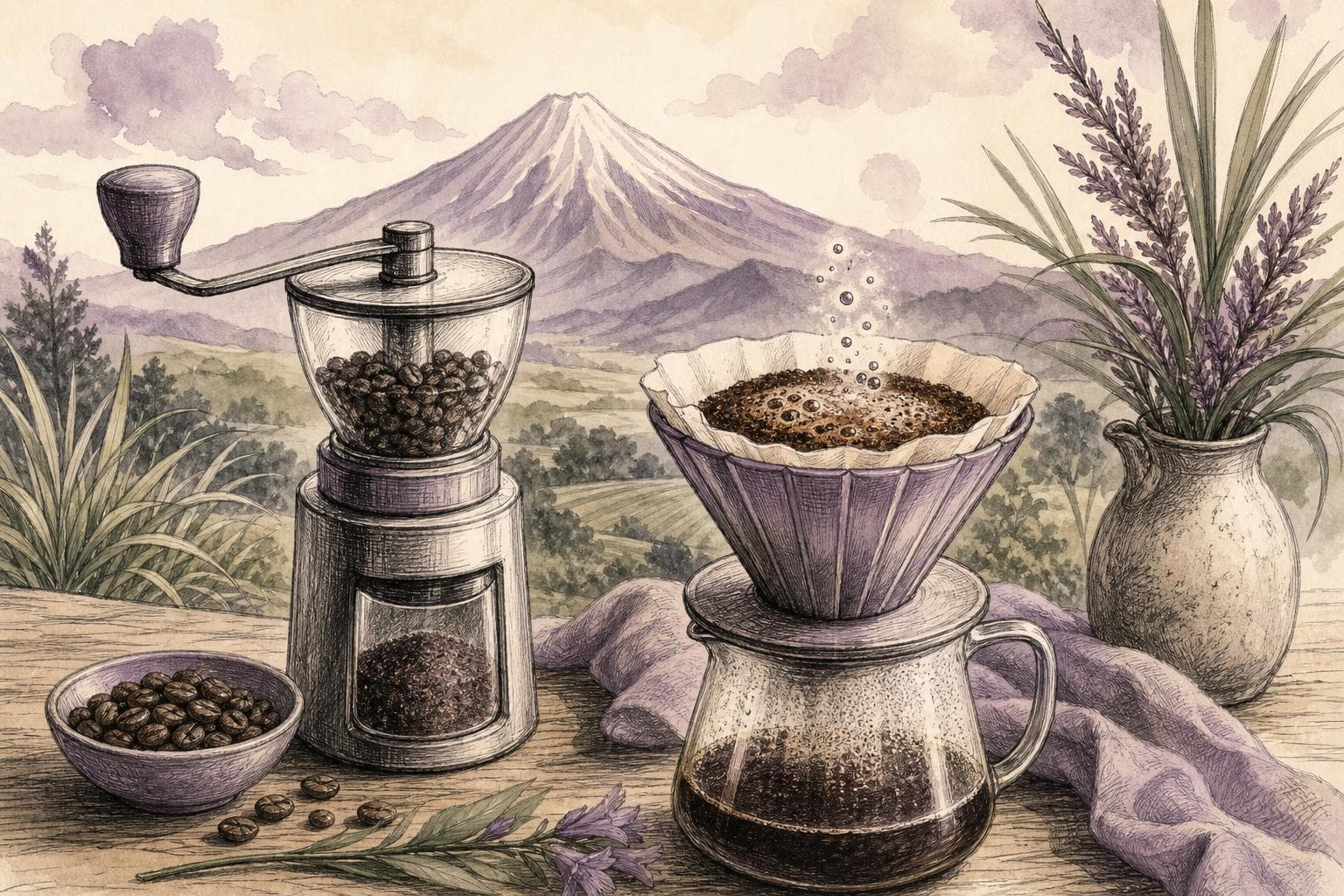
The best way to grind coffee at home in New Zealand is with a burr grinder, set to suit your brew method, used within about 20 minutes of brewing. Burrs crush beans to an even size, so water pulls flavour out evenly. Blades chop beans into dust and boulders, which makes one cup taste sour and bitter at once. Grind coarse for a plunger, medium for pour-over, fine for espresso. Then watch the bloom. If fresh grounds puff up when hot water hits them, that's carbon dioxide leaving the coffee, and it's a sign your beans are still fresh.
Most people upgrade the wrong thing first
We're Naki Roast, and we roast small batches in Eltham, down in south Taranaki. Every bag leaves the drum as whole bean with the roast date stamped on it, which means we get a close look at what happens next.
Here's the pattern. Someone saves up, buys a proper espresso machine, keeps the grinder that came free with a toaster, then wonders why the coffee still tastes flat. They ordered fresh coffee, ground it badly, and the freshness we spent all morning protecting disappeared in about twelve seconds.
Milly's Kitchen in Auckland puts it plainly: customers spend big on an Italian espresso machine, skimp on the grinder, and end up unhappy with the coffee.[millys] The grinder is where the flavour gets decided. Everything after it is just water and timing.
Good news is the fix is cheap and the rules are short.
What a burr grinder does that a blade grinder can't
A burr grinder has two abrasive surfaces, either conical or flat, with the beans passing between them. You adjust the gap to get a finer or coarser grind, and the beans come out roughly the same size every time.[millys] Same mechanism as a decent pepper mill.
A blade grinder is a small food processor. A blunt propeller spins and smashes whatever is in the chamber. It generates heat, and the result is inconsistent enough that Milly's calls blade grinders very poor for quality coffee.[millys] The National Coffee Association is just as blunt: with a blade you can't guarantee a consistent grind, and that hits taste.[ncaplunger]
Why does evenness matter so much? Water doesn't extract at one speed. It pulls fast from small particles and slow from big ones. Grind unevenly and you get fine dust that over-extracts into bitterness sitting next to boulders that under-extract into sourness. Both go in the same cup. That's the cup people describe as "harsh" without being able to say why.
The NCA's recommendation across pour-over, plunger and espresso is the same one word: burr.[ncapourover]
A hand grinder counts. A good manual burr mill will out-grind a cheap electric blade unit every time, and it's quiet at 6am. The trade is about a minute of cranking.
Grind size by brew method
Match the grind to how long the water sits on the coffee. Long contact wants coarse. Short contact wants fine.
| Brew method | Contact time | Grind | What it should look like |
|---|---|---|---|
| Plunger (French press) | About 4 minutes | Coarse | Rough sea salt. Distinct grains you can see |
| Pour-over and filter | 2 to 4 minutes | Medium | Beach sand. Gritty but even |
| Stovetop espresso (moka) | Short | Medium-fine | Fine sand, still loose |
| Espresso machine | 20 to 30 seconds | Fine | Icing sugar that clumps when you squeeze it |
Those times come from the National Coffee Association: about 4 minutes of contact in a plunger,[ncaplunger] 2 to 4 minutes for pour-over,[ncapourover] and 20 to 30 seconds under pressure for espresso.[ncaespresso] A stovetop pot sits somewhere in between, so start medium-fine and adjust from there.
Three more numbers worth writing on the wall. Water should be around 93°C, give or take 3 degrees, which is the figure the NCA takes from SCA Standard 102-2024.[ncapourover] For a plunger, use 1 gram of coffee to somewhere between 10 and 16 grams of water.[ncaplunger] For pour-over, tighten that to 1 gram of coffee per 13 to 16 grams of water.[ncapourover]
Boil the kettle, take it off the heat, wait 30 seconds. That's close enough without a thermometer.
The bloom: what that puff of foam is telling you
Pour a little hot water onto fresh grounds and they swell, bubble and lift. That's the bloom. It isn't decoration.
Roasting fills coffee with carbon dioxide. The bean holds onto it, then lets it go slowly over the days after roasting. When hot water first touches fresh grounds, that trapped gas rushes out.[ncapourover] If you skip the bloom, the escaping gas pushes water away from the grounds it's supposed to be soaking, and your extraction goes patchy.
How to do it, using the NCA's method for pour-over:[ncapourover]
- Weigh your coffee into the filter and level the bed with a light tap.
- Pour double the coffee's weight in water. 15 grams of coffee gets 30 grams of water.
- Wait 30 to 45 seconds, until the bubbling stops.
- Pour the rest slowly and steadily.
The same idea works in a plunger. Wet the grounds, wait half a minute, then fill and put the lid on.
Now the part that matters if you buy fresh coffee. The bloom doubles as a rough freshness check. Coffee starts losing freshness almost from the moment it leaves the roaster,[ncastorage] and the trapped gas goes with it. Recently roasted beans still have plenty to give off, so they lift and bubble. Beans that have sat in a warehouse for months have already released most of theirs, so they barely move.
A flat bloom on its own isn't proof, since grind size and water temperature play a part too. Pair it with the roast date on the bag and you'll know where you stand. No grinder setting fixes old beans.
Why we post whole bean, and grind it at the counter
Every Naki Roast bag we post is 250g of whole bean, roasted after you order it, stamped with the date it came out of the drum. There's no pre-ground option online, and that's on purpose.
The NCA is direct about this: coffee starts losing freshness almost immediately after roasting, so buy in small batches, enough for a week or two, and wait to grind until you're about to brew.[ncastorage] Grinding turns a bean into a huge amount of surface area exposed to air. Milly's puts the practical window at 20 minutes from grind to brew for the best result.[millys] If we ground your coffee on a Tuesday and it reached Auckland on Thursday, we'd be posting you something two days past its best moment.
In person is a different story. Walk into the roastery at 96 Bridge Street, Eltham and we'll grind your bag before you leave. Tell us how you brew it, plunger, filter, stovetop or espresso, and we'll set the grind to match. We'll be straight about the trade: coffee ground at the counter from this morning's roast is worlds ahead of supermarket ground, and it still won't hold its edge as long as whole bean sitting in your cupboard. If you haven't got a grinder yet, take the trade. It beats wrestling a blade grinder every morning.
Store the bag airtight, opaque, somewhere dark and cool, and away from the oven or the afternoon sun. Coffee is hygroscopic, meaning it soaks up moisture and smells from the air around it.[ncastorage] The cupboard, not the windowsill.
A few notes from our own lineup, since grind and roast work together:
- OG Roast is dialled in for espresso and built for milk drinks. Brazil Cerrado, Colombia Medellín and Mexico Altura, washed, medium-dark, with dark chocolate, hazelnut and caramel. Grind it fine and it'll carry a flat white without turning bitter.
- Southern Lights is 100% Brazil Cerrado, dark and rounded. It's forgiving in a plunger at a coarse grind.
- Baghonça puts Arabica and Robusta together, so it's bold and complex. It has the body to stand up to a stovetop.
- Lab Rat is 1kg, and you pick the beans and pick the crack. If you own a grinder you can actually adjust, this is the one to play with.
If you're still stuck on the grinder question, buy the burr grinder first and the fancier machine later. You'll taste it sooner.
When the cup is wrong, change one thing
Don't chase five variables at once. Taste, then move the grind.
- Sour, thin, finishes fast. Under-extracted. Grind finer or brew longer.
- Bitter, dry, sticks to the back of your tongue. Over-extracted. Grind coarser or shorten the brew.
- Sour and bitter together. Uneven grind. That's the grinder, not the recipe. Check the burrs or stop using blades.
- Flat and cardboardy, no bloom. Stale beans. Check the roast date.
Change one setting, brew again, taste again. Two or three rounds and you'll have it.
Keep the grinder clean
Coffee oils go rancid inside a grinder and quietly ruin fresh beans. Brush the hopper, burrs and delivery chute weekly, and do a proper deep clean every few months following your machine's instructions.[millys] Easiest habit is to clean it whenever you open a new bag.
Still on a blade grinder while you save up? Pulse fresh beans, 3 to 14 days from roasting, in small batches so you don't overcrowd the chamber and overwork the coffee.[millys] It's a workaround, not a fix, but it helps.
The short version
Buy a burr grinder before anything else. Grind coarse for a plunger, medium for filter, fine for espresso. Grind within 20 minutes of brewing. Bloom the grounds for 30 to 45 seconds and watch what they do, because that tells you how fresh your coffee really is.
Then get beans worth grinding. Small batch, hand-stamped, roast date on the bag. Fresh from the roaster in Eltham, straight to your door. Close enough to visit? Come in and we'll grind it for you at the counter.
Frequently Asked Questions
What grind size should I use for a plunger or French press?
Coarse, roughly the texture of rough sea salt. The water sits on the grounds for about 4 minutes, so a fine grind would over-extract and leave you with bitterness and silt. The National Coffee Association's numbers for a plunger are 1 gram of coffee to 10 to 16 grams of water, at about 93°C.
Is a burr grinder really better than a blade grinder?
Yes. A burr grinder crushes beans between two adjustable abrasive surfaces and gives you an even particle size. A blade grinder is a small food processor that chops unevenly and heats the coffee, which the National Coffee Association says you can't rely on for a consistent grind. Uneven grounds give you a sour and bitter cup at the same time.
Can you grind the beans for me?
In person, yes. Walk into the roastery in Eltham, tell us how you brew, and we'll grind your bag to match before you leave. Online orders go out as whole bean only, because ground coffee loses its edge in transit and we would rather you got the good version.
Why do you bloom coffee before brewing?
Roasting leaves carbon dioxide trapped in the bean. When hot water first hits fresh grounds, that gas escapes and pushes water away from the coffee. The National Coffee Association's method is to pour a small amount first, about double the coffee's weight in water, and let the gas out over 30 to 45 seconds, so the rest of the pour soaks the bed evenly.
Does fresh coffee bloom more than old coffee?
Fresher coffee still holds the gas that roasting created, and it hasn't had time to release it, so it reacts more visibly when hot water hits it. Coffee that has been ground or sitting for months has already lost most of that gas. A weak bloom is a reasonable hint that beans are past their best, alongside checking the roast date on the bag.
How long after grinding should I brew?
About 20 minutes at the outside, and sooner is better, according to Milly's Kitchen. Grinding exposes far more surface area to air, which is why the National Coffee Association recommends waiting to grind until you're ready to brew.
How often should I clean my coffee grinder?
Brush the hopper, burrs and chute weekly, and do a full deep clean every few months according to your grinder's instructions. That is Milly's Kitchen's advice, and the reason is simple: old coffee oils turn rancid and will taint fresh beans.
Sources
- aboutcoffee.org: National Coffee Association guidance on burr grinders, the bloom step and carbon dioxide release, and the 93°C ± 3°C water temperature from SCA Standard 102-2024.
- aboutcoffee.org: National Coffee Association French press ratios, 4 minute brew time and brewing temperature, plus blade grinder inconsistency.
- aboutcoffee.org: National Coffee Association description of espresso as finely ground coffee extracted under pressure in about 20 to 30 seconds.
- aboutcoffee.org: National Coffee Association storage advice on buying small batches, airtight and opaque containers, coffee being hygroscopic, and waiting to grind until brewing.
- millyskitchen.co.nz: Milly's Kitchen guide to burr versus blade mechanics, the 20 minute grind-to-brew window, weekly and deep cleaning, and pulsing blade grinders with beans 3 to 14 days from roasting.