
Arabica vs Robusta in NZ, and Where Single Origin Fits
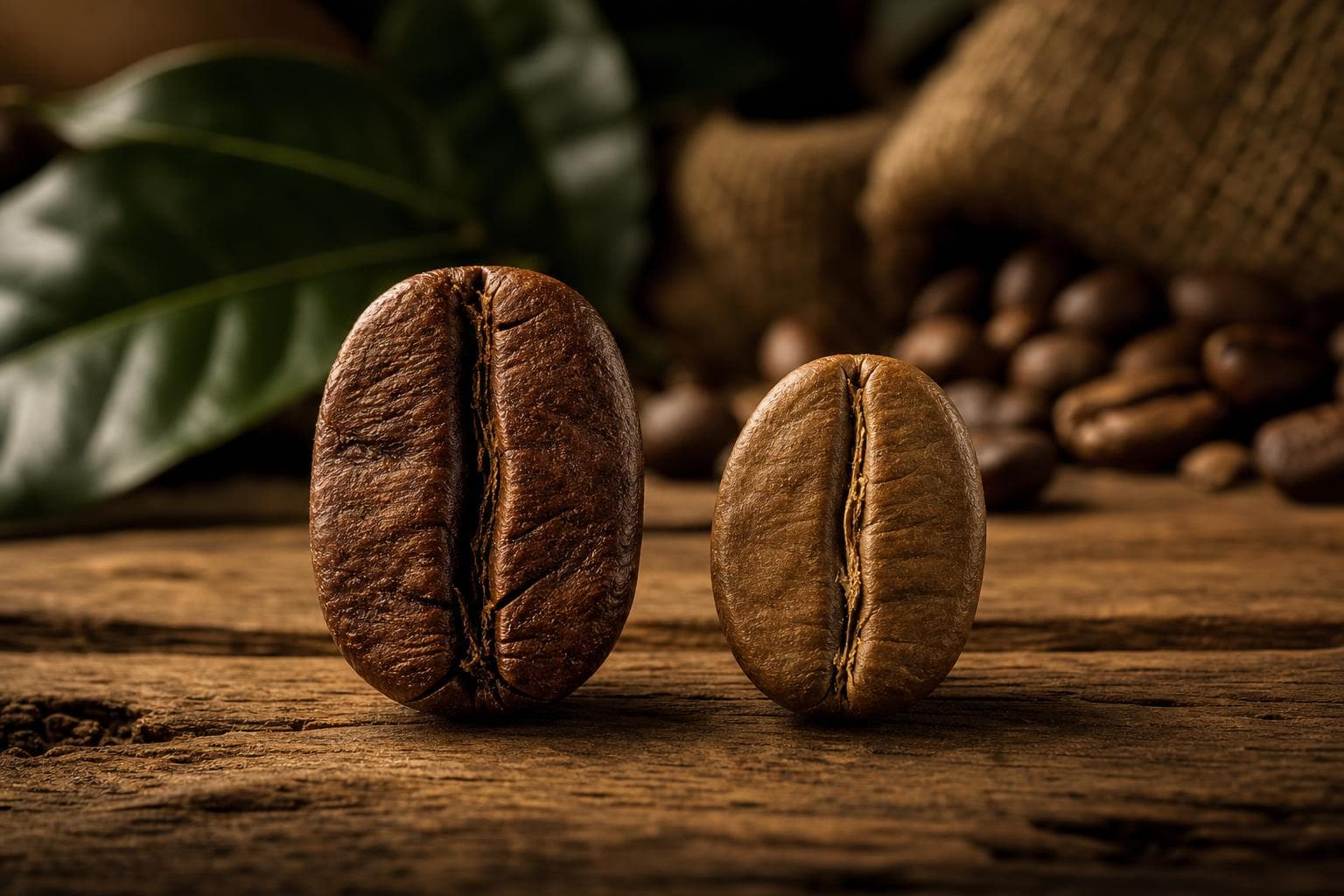
Almost every bag on a New Zealand shelf is Arabica, and most of the good ones say so. Robusta is the other species: less sugar, more caffeine, thicker crema, and a bad reputation it mostly earned from cheap beans roasted badly. Single origin means one source, not automatically better coffee. Here's what each one does in the cup, and how we use all three at Naki Roast.
Most coffee arguments in this country are really one argument. Someone says Robusta is rubbish. Someone else says single origin is the only honest way to buy beans. Both of them are half right and neither of them is talking about what's actually in your cup tomorrow morning.
Naki Roast roasts in Eltham, south Taranaki, in small batches, and we've got bags on the shelf that sit on every side of this. One is 100% Arabica from three origins. One is a single origin with nothing else in the bag. Two have Indian Robusta in them on purpose. So this is the plain version, from the drum.
Two species, and what each one actually does
Nearly all coffee sold anywhere comes from two species. Coffea arabica and Coffea canephora, which everyone calls Robusta.
Arabica grows high and slow. Cooler air, more altitude, more time on the branch. That slow ripening is where the sweetness and the fruit and the bright notes come from. It's fussier to grow, more prone to disease, and it yields less per hectare, which is why it costs more.
Robusta grows low, hot and hardy. It ripens faster and it fights off pests better. In the cup it's earthier and more bitter, with a heavier body and a thicker crema. Brewed on its own from cheap beans it can taste like burnt tyres. Brewed from good beans, roasted properly, it tastes like dark chocolate with a bit of grit behind it.
Here's the short version.
| Arabica | Robusta | |
|---|---|---|
| Grows | High and cool | Low and hot |
| Caffeine, green bean | About 0.9 to 1.5% dry weight[caffeine] | About 1.2 to 2.4% dry weight[caffeine] |
| In the cup | Sweet, fruity, brighter acidity | Earthy, bittersweet, dark chocolate |
| Body and crema | Lighter, finer | Heavier, thicker crema |
| Usual job | Carries the flavour | Carries the punch and the body |
Two things worth saying about that caffeine row, because the internet gets it wrong in both directions. Robusta is not "double the caffeine" as a rule. The ranges overlap. A strong Arabica can beat a weak Robusta. But at the top end Robusta goes roughly twice as high, and most Robusta you'll meet in an espresso blend sits well above most Arabica.[caffeine]
Robusta isn't a fringe bean
The snob version of the story treats Robusta as filler. The numbers don't back that up. In coffee year 2022/23 Arabica took 55.9% of world production, which leaves Robusta at 44.1%.[ico] Close to half the coffee grown on earth. It's in a fair chunk of the espresso you drank in Italy. It built the instant aisle. It just doesn't get printed on the front of the bag.
There's also a grading standard for the good stuff, which surprises people. The Coffee Quality Institute runs one set of certification standards covering Specialty Arabica and Fine Robusta, and certification means no primary defects and a cup score of 80 points or more.[cqi] Same bar, same 100 point scale, either species.
So when someone tells you Robusta is inherently bad coffee, what they mean is that cheap Robusta is bad coffee. True. Cheap Arabica is bad coffee too. Nobody writes blog posts about that.
We wrote the longer case for it in In defence of Robusta, if you want the full argument and the reason The Mule kicks.
What single origin means, and what it doesn't
Single origin means the beans in the bag come from one place. Sometimes that's one country, sometimes one region, sometimes one farm. The tighter the definition, the more the label is telling you.
What it does: it lets a place taste like itself. Nothing is blended in to round off the edges, so you get that origin's character, sweetness, acidity and all. It also makes the bag traceable in a way a four origin blend never is.
What it doesn't do: guarantee a better cup. Single origin isn't a quality grade. It's a sourcing fact. A mediocre single origin is still mediocre, and a good blend can beat it before breakfast. The reason single origin gets popular in New Zealand is the same reason it gets popular anywhere: people want to know where their food comes from, and one origin is easier to know than four.
Our single origin is Southern Lights, NZ$17 for 250g. Pure Brazil Cerrado, nothing else in the bag. Dark, rounded and full bodied, with no sharp edges and nothing fighting through the finish. One origin taken exactly where we wanted it to go.
Why we use both
Blending gets treated like the cheap option. It isn't. Blending is how you build a cup that does a specific job, and you can't always get there from one origin.
OG Roast, NZ$18 for 250g, is 100% Arabica. Brazil Cerrado, Colombia Medellín and Mexico Altura, washed, roasted medium dark. Three origins, one species, dialled in for espresso and built to hold up in milk. No harshness, no stomach drama. It's the bag for people who want a flat white that tastes the same good way every morning.
The Mule, NZ$18 for 250g, is four origins and about a quarter Indian Robusta. The Arabica does the talking. The Robusta brings the crema and the kick. A quarter is deliberate: more than that and the Robusta stops being the backbone and starts being the whole conversation.
Baghonça, NZ$17 for 250g, pushes it further. India and Brazil, Robusta and Arabica, in a bag built for pressure. Brazil brings the chocolate and the weight. India brings the claws. Pull it as an espresso and the crema stacks up thick.
Same roastery, three different answers, because "which is better" was never the right question. The right question is what you're brewing tomorrow.
Which bag for which brew
- Filter, pour-over or plunger. Go single origin or 100% Arabica. There's no pressure to build crema and no milk to cut through, so the sweetness and the acidity are the whole point. Southern Lights or OG Roast.
- Flat white or latte. Either works. OG Roast gets there on Arabica alone with a rounded, milk friendly body. The Mule gets there with Robusta doing the heavy lifting, and it stays louder under more milk.
- Straight espresso or moka pot. This is where Robusta earns its spot. Baghonça or The Mule. Thick crema, bittersweet depth, no milk needed to make sense of it.
- Early starts and long shifts. The Robusta blends, on caffeine alone.[caffeine]
- You want to taste one place. Single origin, obviously. Southern Lights.
What to check on the bag
Species and origin are useful. Freshness decides more.
Look for a roast date, not a best before. A best before date tells you when someone's lawyer stopped worrying. A roast date tells you where the coffee is in its life. Whole bean over pre-ground, every time, because ground coffee goes flat in days. And if the bag lists origins, count them, then decide whether you want one place or a built cup.
Every bag we send out is roasted to order in small batches and hand stamped with its batch and roast date, so you always know how old your coffee is. Fresh from the roaster, straight to your door.
Naki Roast, 96 Bridge Street, Eltham, Taranaki. Born between two peaks.
All prices are in NZD and were checked on 15 September 2026.
Frequently Asked Questions
Which has more caffeine, Arabica or Robusta?
Robusta, usually. Green Arabica beans average about 0.9 to 1.5% caffeine by dry weight, Robusta about 1.2 to 2.4%.[caffeine] The ranges overlap at the bottom, so a specific Arabica can beat a specific Robusta, but at the top end Robusta roughly doubles it.
Is Robusta bad coffee?
Cheap Robusta is. So is cheap Arabica. The Coffee Quality Institute certifies Fine Robusta against the same requirement it uses for Specialty Arabica: no primary defects and a cup score of 80 or more.[cqi] Good Robusta exists. You just have to buy it from someone who cares.
Does single origin mean better coffee?
No. It means one source, which is a sourcing fact, not a quality grade. Single origin gives you a place tasting like itself. A well built blend can still make a better espresso.
Why do roasters put Robusta in espresso blends?
Body and crema, plus the caffeine. Robusta brings a heavier mouthfeel and a thicker crema layer than Arabica manages alone, and a bittersweet depth that survives milk instead of disappearing into it. That's why we put about a quarter of it in The Mule.
Can you use Robusta blends for filter coffee?
You can, but it's not where they shine. Without pressure you lose the crema, which is half the reason the Robusta is there. Keep it strong if you try it, or reach for a single origin instead.
Sources
- pmc.ncbi.nlm.nih.gov: "Influence of Various Factors on Caffeine Content in Coffee Brews" in Foods, giving green bean caffeine of 0.9 to 1.5% dry weight for Arabica and 1.2 to 2.4% for Robusta.
- icocoffee.org: International Coffee Organization Coffee Report and Outlook, December 2023, reporting Arabica's world market share at 55.9% and Robusta's at 44.1%.
- database.coffeeinstitute.org: Coffee Quality Institute Quality Evaluation Program Guidebook, covering standards for Fine Robusta and Specialty Arabica and requiring no primary defects and a cup score of 80 points or more.